

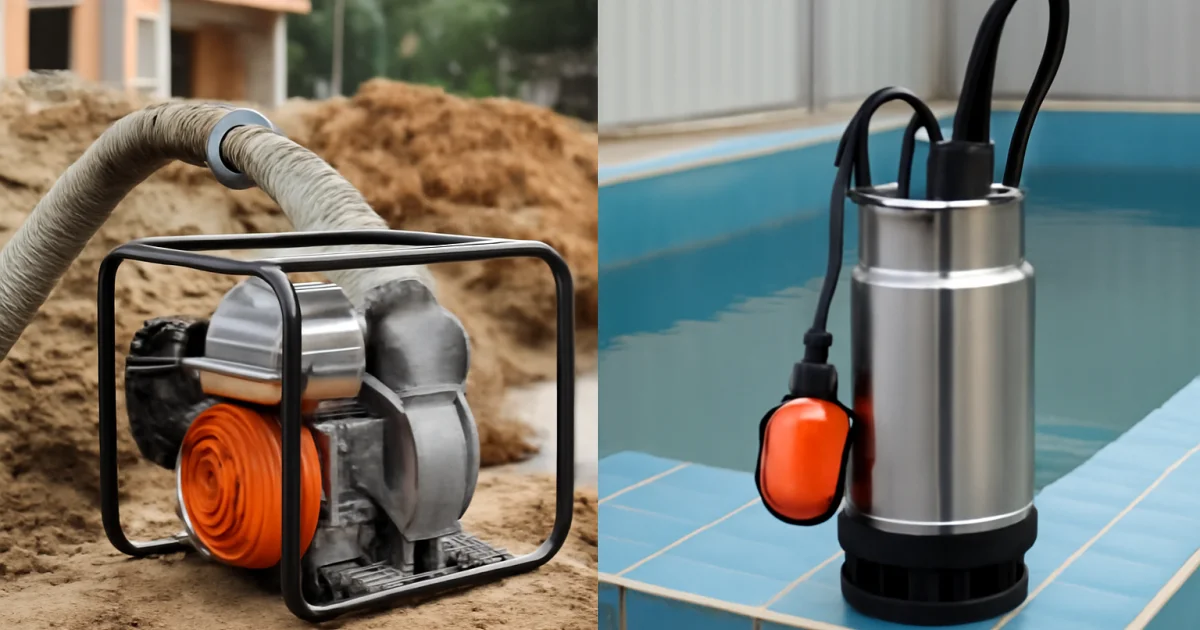
Looking for the best drainage pump in Malaysia? This drainage pump Malaysia guide starts with one point: a drainage pump and a submersible pump are not necessarily alternatives. Drainage describes the job of removing unwanted water; submersible describes a pump designed to operate in liquid within its specified installation limits. Many drainage pumps used in Malaysia are submersible. The useful comparison is therefore between submersible drainage pumps, submersible sewage or wastewater pumps, and suitable non-submersible dewatering arrangements.
For construction contractors, building managers and factory maintenance teams, the right choice depends on what is in the water, the flow and head required, the sump or site arrangement, and how the pump will be operated and serviced.
Quick Answer: Drainage Pump vs Submersible Pump
For rainwater or relatively clean seepage, assess a drainage-rated pump with suitable particle passage. For sewage or wastewater containing solids and fibrous material, assess a wastewater- or sewage-rated pump specifically designed for those conditions. Both categories may be submersible. A surface-mounted pump may be appropriate where the suction conditions, priming, accessibility and application allow it.
Which Is the Best Drainage Pump for Your Job?
There is no single best drainage pump for every site. The best drainage pump is the one that matches the water, the solids and the duty point. Use this shortlist as a starting point:
| Job | Pump type to evaluate | Where to start |
|---|---|---|
| Basement sump, rainwater, seepage | Submersible drainage pump with automatic float switch | KPC drainage submersible pump or Grundfos domestic submersible pumps |
| Muddy construction site water | Dirty-water or construction dewatering pump | Share the sand content, inflow and discharge head with the supplier first |
| Wastewater or sewage chamber | Submersible wastewater or sewage pump | Submersible sewage pumps and our sewage pump installation guide |
| Industrial drainage, factory washdown, corrosive liquid | Stainless steel submersible pump rated for the liquid | Stainless steel submersible sewage pump (confirm chemical compatibility) |
What Makes a Drainage Pump the Best Choice?
- Right duty point: it delivers the flow you need at your total head.
- Right solids passage: it passes the particles in your water without clogging.
- Automatic control: a float or level switch starts and stops it so it does not run dry.
- Right materials: cast iron, stainless steel or plastic to suit the liquid and abrasion.
- Local support: spare parts and service available in Malaysia when you need them.
What Is a Drainage Pump in Malaysia?
A drainage pump removes accumulated water from a sump, excavation, basement, pit or other low point. Common tasks include rainwater removal, groundwater seepage control and temporary construction dewatering. Drainage pumps can be portable or permanently installed, and many models are submersible. Their allowable particle size, liquid temperature, operating duration and immersion limits depend on the specific model.
The label “drainage pump” does not mean every model can handle sand, cement slurry, sewage or construction debris. Abrasive solids and fibres may require different hydraulics, materials or a different pump category.
What Is a Submersible Pump?
A submersible pump is built for operation in liquid according to its manufacturer’s installation instructions. The term covers different products: clean-water drainage pumps, dirty-water drainage pumps, sewage pumps, borehole pumps and other specialist designs. It does not mean every submersible model can pump sewage, slurry or corrosive liquids.
Also, “submersible” does not guarantee unrestricted dry running or continuous operation. Some models permit limited low-water operation; others rely on specified liquid levels for motor cooling. Follow the particular pump data sheet and installation manual.
Comparison: Which Pump Category Fits the Water?
| Pump category | Typical application | Liquid and solids considerations | Important selection check |
|---|---|---|---|
| Submersible drainage pump | Basement sump, rainwater, relatively clean seepage | Often suitable for clean or lightly contaminated water; permitted particles vary by model | Solids passage, minimum water level, float-switch clearance |
| Dirty-water or construction dewatering pump | Excavations, trenches, muddy site water | May handle some suspended particles; abrasive sand and slurry need specific assessment | Abrasive wear, strainer arrangement, discharge hose and duty |
| Submersible sewage / wastewater pump | Sewage sump, wastewater lift station | Designed for the stated solids and fibre loading; impeller and free passage vary | Free passage, clogging risk, guide rails, controls and service access |
| Surface-mounted dewatering pump | Accessible above-ground temporary installation | Suitability depends on suction lift, priming and fluid characteristics | Priming, suction losses, NPSH and safe hose routing |
This table is a screening guide, not a substitute for manufacturer performance curves or a site-specific design. A sewage pump is not automatically the correct choice for abrasive slurry, and a drainage pump is not automatically restricted to intermittent use.
Five Checks Before Selecting a Drainage or Submersible Pump
1. Identify the Liquid, Not Just the Location
Describe whether the pump will handle rainwater, groundwater, washdown water, wastewater, sewage, or water carrying sand and construction fines. Identify likely solids size, concentration, fibres, oil, chemicals and temperature. A pump suited to clean rainwater may clog or wear rapidly in a sediment-heavy excavation.
2. Calculate Required Flow and Total Dynamic Head
Estimate the incoming water rate or the volume that must be removed within the required time. Then calculate the required head at that flow, accounting for elevation, pipe and hose friction, fittings and discharge conditions. The required duty point is the combination of flow and head; do not select on horsepower or maximum flow alone.
For the calculation method and an explanation of pump curves, read Multipump’s water pump sizing guide for Malaysia.
3. Check Solids Passage and Wear Resistance
Ask for the manufacturer’s maximum free passage or permitted particle size and the conditions attached to it. These figures are model-specific; a larger nominal opening does not necessarily mean reliable handling of fibrous material. Sand can cause abrasion even when particles are small enough to pass through the pump.
4. Match the Installation and Controls
A portable pump in a construction pit has different needs from a fixed basement sump. Check minimum operating water level, available sump space, cable routing, electrical protection, float or level sensor arrangement, non-return valve, alarm provision and access for lifting the pump. Critical drainage installations may require standby capacity or high-level alarms as specified by the project designer.
5. Review Duty, Maintenance and Site Safety
Confirm whether operation is occasional, frequent or continuous, and whether the selected pump is rated for that duty. Plan for strainer inspection, sediment removal, cable and seal checks, safe lifting and isolation before maintenance. Submerged electrical equipment is not inherently risk-free; installation and servicing require appropriate protection and competent personnel.
Application Examples for Malaysian Projects
| Site scenario | Initial pump category to evaluate | What must be verified |
|---|---|---|
| Construction excavation after rain | Portable drainage or construction dewatering pump | Inflow, discharge head, sand content, power supply, sediment control |
| Commercial basement sump | Fixed submersible drainage pump | Sump volume, level controls, peak inflow, alarm and standby requirements |
| Factory washdown pit | Drainage or wastewater pump depending on liquid | Debris, fibres, chemicals, temperature and compatibility |
| Sewage collection chamber | Submersible sewage / wastewater pump | Solids passage, clog resistance, access and control system |
| Floodwater containing debris | Application-specific dewatering pump | Debris size, safe access, discharge location and electrical hazards |
These are illustrative scenarios, not reports of completed Multipump projects. Site conditions and engineering requirements determine the final selection.
Common Selection Mistakes
- Comparing drainage and submersible as opposite types: many drainage pumps are submersible.
- Assuming all submersible pumps handle sewage: the liquid-handling design must match the application.
- Choosing by horsepower: the pump must meet flow at the required head.
- Ignoring abrasive sand or fibres: passing particles and resisting wear are separate questions.
- Assuming every submersible pump runs dry: check the model’s cooling and minimum-level limits.
- Overlooking controls and maintenance access: sump geometry and alarms can matter as much as the pump itself.
Information to Send a Pump Supplier Before Requesting a Quotation
| Information | Useful detail |
|---|---|
| Application | Basement sump, construction pit, sewage chamber or industrial drain |
| Liquid | Clean water, sediment, wastewater, sewage, fibres, temperature and chemicals |
| Required capacity | Estimated inflow or volume to remove and target pumping time |
| Discharge system | Vertical lift, hose or pipe diameter, length, fittings and discharge point |
| Site layout | Pit dimensions, minimum water level, access and installation type |
| Electrical and control | Available supply, float switches, alarms, duty/standby requirements |
| Existing equipment | Pump model, nameplate, observed problems and site photos |
Multipump supplies pump solutions and supports installation, replacement, servicing and related control systems. Buyers in Penang, Kedah and elsewhere in Malaysia can start with the site information above rather than selecting a model from a product label alone. Discuss your requirements through the Multipump website.
Technical References
For model-specific limits, use the manufacturer’s published instructions and pump curves. The following publicly accessible manufacturer resources explain the differences between drainage, effluent and sewage pumping:
- Grundfos: Which pump do I need for drainage water? — examples of drainage models with different stated solids passage.
- Grundfos ECADEMY: Drainage, greywater, rainwater and blackwater applications — explains portable and fixed submersible drainage arrangements.
- Xylem / Flygt: Submersible electric pumps for sewage (technical catalogue) — illustrates why solids passage and duty limits must be checked for individual models.
Frequently Asked Questions
Is a drainage pump the same as a submersible pump?
Not exactly. Drainage describes the task of removing water, while submersible describes a pump designed to operate in liquid. Many drainage pumps are submersible, but submersible pumps also include sewage, borehole and other specialised types.
Can a submersible drainage pump handle sewage?
Only if the specific model is rated for the liquid and its solids or fibres. A clean-water drainage pump should not be assumed suitable for raw sewage.
Which pump is suitable for construction site dewatering in Malaysia?
It depends on the inflow, required flow and head, sand or debris content, electrical supply and installation. A portable drainage or construction dewatering pump may be suitable after the actual site conditions are assessed.
How do I size a drainage pump for a basement sump?
Estimate peak incoming water flow, sump storage, required discharge flow, static lift and pipe losses. Compare the resulting duty point with manufacturer curves and review level controls, alarms and any standby requirement.
Can submersible pumps run continuously or without water?
Continuous-duty and minimum water-level limits depend on the pump model and installation. Do not assume that every submersible pump can run continuously or dry; follow the manufacturer’s instructions.
What should I provide to a pump supplier in Malaysia?
Share the application, liquid characteristics, estimated flow, discharge elevation and piping, sump dimensions, electrical supply, operating duty and any existing pump details. This helps the supplier identify suitable models for technical review.
What is the best drainage pump to buy?
The best drainage pump to buy is one rated for your water (clean, dirty or sewage), with enough solids passage, the right flow at your total head, an automatic float switch and local service support. For a home or basement sump this is usually a submersible drainage pump; for sewage it is a sewage-rated pump.
What is the best water pump brand in Malaysia?
No single brand is best for every job. Choose a well-known brand with genuine local warranty, spare parts and service. Multipump supplies Grundfos pumps alongside other pump products, so you can compare options for your application.
What is an industrial drainage pump?
An industrial drainage pump removes water or process liquid from factory pits, washdown areas and plant drains. It often needs stronger materials such as stainless steel, higher solids handling and continuous-duty rating, depending on the liquid.
Discuss Your Drainage or Submersible Pump Requirement
The best pump is the one that matches the water, site and duty point—not the broadest product label. Contact Multipump Sdn. Bhd. with your application details for a suitable product and technical support discussion.