


Choosing the right water pump requires more than comparing motor horsepower or maximum flow rates. The pump must deliver enough water for the application while providing sufficient head to overcome elevation, pipe friction and other system requirements.
Pump sizing usually begins with two key figures: flow rate and head. Together, they form the required duty point. This duty point can then be checked against a manufacturer’s pump performance curve to identify pumps that may suit the application.
The same principles apply across many residential, commercial and industrial applications in Malaysia. The actual requirements, however, can vary considerably between a domestic pressure booster system, a building water supply, an industrial transfer system and a drainage application.
Quick Answer: To determine what size water pump you need, estimate the required flow rate (L/min or m³/h), calculate the total dynamic head (m), and combine them as a duty point. Then check whether a specific pump’s performance curve can deliver that flow at that head. Do not select a pump based on HP or maximum flow alone.
1.0 What Information Do You Need Before Sizing a Water Pump?
A reliable pump selection starts with accurate information about the system. Flow demand is important, but elevation, piping, pressure requirements and the liquid being pumped can all affect the final choice.
For example, two systems may require the same flow rate but have very different head requirements. One may transfer water over a short distance with little elevation change, while another may need to lift water several floors through a longer piping network.
Collect the following information before comparing pump models.
| Information | Why It Matters |
|---|---|
| Application | Identifies whether the pump is used for water transfer, pressure boosting, drainage, wastewater or another purpose. |
| Required Flow Rate | Shows how much water the system needs within a specific period. |
| Elevation / Static Head | Helps establish the vertical elevation that the pump needs to overcome. |
| Pipe Length | Longer pipe runs can increase friction loss within the system. |
| Pipe Diameter & Type | Pipe dimensions and characteristics influence water velocity and friction loss. |
| Valves & Fittings | Elbows, valves, tees and other fittings add resistance to the piping system. |
| Fluid | The type and properties of the liquid can affect the choice of pump. |
| Required Pressure | Some applications require a specified pressure at the discharge point. |
| Electrical Supply | The motor and electrical configuration must suit the available power supply. |
Once these details are available, the sizing process can be organised into a simple sequence:
Application → Required Flow → Required Head → Duty Point → Pump Performance Curve → Pump Selection
1.1 Water Pump Sizing by Application in Malaysia
The right water pump size depends on the job, not just the number of bathrooms, pipe diameter or motor horsepower. Use this table to identify which requirements to collect first.
| Application | Main Sizing Considerations | Pump Type to Evaluate |
|---|---|---|
| House / residential water supply | Simultaneous outlet demand, incoming pressure, building height and required outlet pressure | Domestic pressure booster pump |
| Commercial building | Peak demand, pressure zones, building height and control requirements | Booster pump system |
| Industrial water transfer | Required flow, source and destination levels, pipe friction and operating hours | Centrifugal or multistage pump, subject to duty point |
| Basement or sump drainage | Incoming water rate, sump volume, discharge head and liquid characteristics | Submersible drainage pump where appropriate |
| Wastewater transfer | Flow, head, solids handling, fluid characteristics and discharge route | Wastewater submersible pump |
Important: This table identifies suitable pump categories for evaluation; it does not prescribe a fixed HP, L/min or model. Final selection requires actual system data and manufacturer performance curves.
2.0 What Is Flow Rate in Water Pump Sizing?
Flow rate describes the volume of water that moves through a system within a given period. It is commonly expressed in:
- Litres per minute (L/min)
- Litres per second (L/s)
- Cubic metres per hour (m³/h)
The required flow rate depends on the application. A residential water supply may be based on expected household demand, whereas an industrial transfer system may have a defined process flow. Drainage applications have different requirements again because the pump needs to remove incoming water at a suitable rate.
Establishing the required flow gives you a practical starting point for pump sizing. Motor horsepower becomes relevant later, once the hydraulic requirements of the system are clearer.
2.1 Why Does Flow Rate Matter?
Flow rate forms one part of the required duty point.
Suppose a system needs 100 L/min. That figure tells us how much water must be delivered, but it does not yet identify a suitable pump. We also need to know the head at which the pump must deliver those 100 litres per minute.
A pump capable of producing 100 L/min under low-head conditions may deliver a different flow when connected to a system with a higher head requirement.
2.2 Maximum Flow vs Actual Operating Flow
Pump catalogues often show a maximum flow rate. This figure can be useful when comparing models, although it should not be treated as the flow that the pump will deliver in every installation.
For a typical centrifugal pump, flow and head change together along the pump’s performance curve. As the system imposes more or less head, the resulting flow can also change.
The actual operating condition therefore depends on both the pump and the system connected to it.
2.3 Does a Higher HP Water Pump Provide More Flow?
Not in every case.
Horsepower describes motor power, while flow rate describes hydraulic output. Pump design, impeller characteristics, speed, efficiency and operating head all influence the amount of water a particular pump can deliver.
As a result, two pumps with similar motor ratings can have different flow-head characteristics. A 1.5 HP rating on its own cannot tell you how many litres per minute the pump will deliver in a particular installation.
2.4 Quick Water Pump Sizing Terms
| Term | Simple Meaning |
|---|---|
| Flow Rate (Q) | How much water is required per minute or hour. |
| Head (H) | The hydraulic energy the pump must provide, commonly expressed in metres. |
| Duty Point | The target flow and head together, such as 120 L/min @ 20 m. |
| Pump Curve | Manufacturer data showing flow and head performance of a particular pump. |
3.0 What Is Pump Head?
Pump head describes the energy that a pump provides to the liquid and is commonly expressed in metres of liquid. In practical pump selection, it represents the hydraulic requirement the pump must overcome while delivering the required flow.
Head should not be confused with the total length of the pipe.
A system may contain 100 metres of horizontal piping without having 100 metres of static head. The length of that pipe still matters because it contributes to friction loss, but the vertical elevation and friction components need to be considered separately.
4.0 What Is Static Head?
Static head relates to the elevation difference between relevant points in the system.
Consider a simple application that transfers water from a lower open tank to another open tank. If the destination water level is 15 metres above the source water level, that elevation difference contributes approximately 15 metres of static head.
The pump needs enough energy to overcome this elevation while maintaining the required flow.
This distinction becomes important when reviewing piping layouts. A long horizontal pipe can add significant friction without adding an equivalent amount of static head. Conversely, a relatively short pipe that rises steeply may have a substantial static head requirement.
5.0 What Is Friction Loss in a Pumping System?
Water loses energy as it travels through a piping system. This resistance is generally referred to as friction loss or friction head.
Several factors influence the amount of friction in a system:
- Flow rate
- Pipe length
- Pipe diameter
- Pipe material and internal characteristics
- Elbows
- Valves
- Tees
- Other fittings and components
Friction loss also changes with flow. Increasing the amount of water moving through the same piping system changes the resistance that the pump has to overcome.
Pipe diameter can make a significant difference as well. Moving a given flow through a more restrictive pipe increases water velocity and can increase friction losses.
For this reason, pump sizing and piping design are closely related. A change in the piping arrangement can alter the system head and, consequently, the pump’s operating condition.
6.0 What Is Total Dynamic Head (TDH)?
Total Dynamic Head (TDH) represents the overall head requirement that the pump needs to overcome at the required flow.
For a simple open water-transfer system, an introductory calculation may be expressed as:
Required Head ≈ Static Head + Friction Loss
Suppose water needs to be transferred between two open tanks with a static head of 15 metres. If the piping and fittings produce an estimated friction loss of 5 metres at the required flow, the approximate head requirement would be 20 metres.
| Requirement | Example |
|---|---|
| Static Head | 15 m |
| Estimated Friction Loss | 5 m |
| Approximate Required Head | 20 m |
6.1 Is TDH Always Static Head Plus Friction Loss?
No. The calculation above is suitable for explaining a simple open transfer system, but many real installations have additional requirements.
A pump may need to discharge into a pressurised system, maintain a specified pressure at the destination or overcome losses through equipment and other components. These requirements can add to the total head.
More complex commercial and industrial systems therefore need to be assessed according to their actual hydraulic conditions rather than relying on the simplified calculation alone.
7.0 How Do You Calculate the Pump Duty Point?
Once the required flow and head are known, they can be combined into a duty point.
For example, assume that a system requires:
Required Flow Rate: 100 L/min
Required Head: 25 m
The required duty point is:
100 L/min @ 25 m head
This gives a pump supplier or engineer a clear hydraulic target. The relevant pump curves can then be reviewed to find models capable of operating around the required condition.
A duty point is more informative than flow, head or motor power considered separately because it describes the required hydraulic performance as a combination of flow and head.
8.0 How Do You Read a Pump Performance Curve?
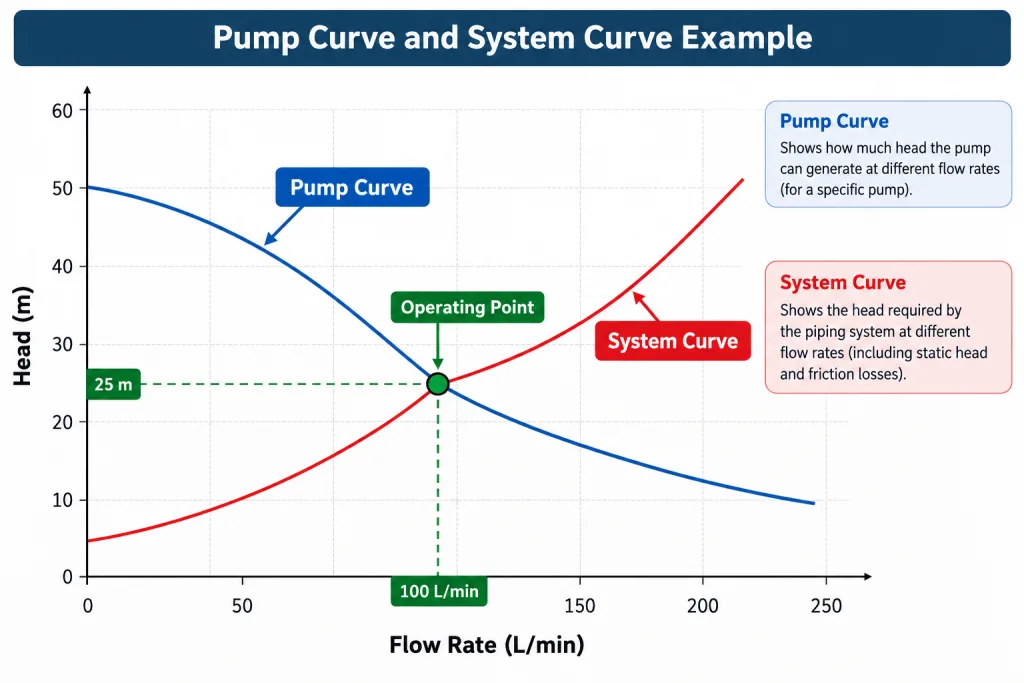
A pump performance curve shows how a particular pump performs across a range of flow and head conditions.
On a typical head-flow curve:
- X-axis = Flow Rate (Q) — the volume of liquid delivered over time.
- Y-axis = Head (H) — the head produced by the pump.
- Pump Curve — the relationship between flow and head for that pump under specified conditions.
Quick Answer: Find the required flow rate on the horizontal axis and the required head on the vertical axis. The point created by these two values can then be compared with the manufacturer’s pump curve to assess whether the pump can operate around the required duty.
8.1 Why Maximum Flow Alone Is Not Enough
Maximum flow usually represents one end of a pump’s operating range under specified test conditions. Once the pump is connected to an actual system, it has to work against the head created by that system.
The useful part of the performance curve is therefore the area around the required duty point. It shows whether the pump can provide the required flow while operating against the expected head.
A model with a very high published maximum flow may still be unsuitable if its performance at the required head does not match the application.
9.0 What Is a System Curve?
A pump performance curve represents the hydraulic performance of a particular pump, while a system curve represents the head required by the piping system at different flow rates.
Part of the system head may remain relatively constant. For example, the elevation difference between two fixed water levels does not change simply because the flow increases.
Friction behaves differently. As flow through the piping changes, friction loss also changes. The system curve reflects how these requirements combine across different flow rates.
9.1 What Is the Operating Point?
When a pump operates in a typical fixed-speed system, its actual flow and head are influenced by the characteristics of both the pump and the system.
The point where the pump curve intersects the system curve represents the operating point.
This is slightly different from the required or design duty point. The design duty point is the target established during the sizing process, while the operating point describes where the selected pump and actual system interact.
| Term | Meaning |
|---|---|
| Required / Design Duty Point | The target flow and head established from the system requirements. |
| Pump Curve | Shows the flow-head performance of a particular pump. |
| System Curve | Represents how the system head requirement changes with flow. |
| Operating Point | The point where the pump curve and system curve intersect in a typical fixed-speed system. |
10.0 What Else Should You Check on a Pump Performance Curve?
Flow and head provide the foundation for pump sizing, although manufacturers may include additional information on their performance charts.
Depending on the pump and application, useful data may include:
- Efficiency
- Motor or input power
- Operating range
- Impeller information
- NPSH requirements
- Speed
- Other model-specific performance data
For an initial selection, focus first on whether the pump can meet the required flow and head. A final technical evaluation can then consider efficiency, motor requirements, suction conditions, fluid properties, installation arrangements and manufacturer recommendations.
11.0 Water Pump Sizing Example: Step-by-Step Calculation
The following example brings the main sizing concepts together. It uses a simple open-tank water-transfer system so that the calculation remains easy to follow.
Assume that water needs to be transferred from a lower open tank to a higher open tank.
This is an illustrative example rather than a final design calculation for a specific installation.
Step 1: Determine the Required Flow Rate
Assume that the application requires:
Required Flow Rate = 120 L/min
The selected pump therefore needs to provide approximately 120 litres per minute at the required system head.
Step 2: Determine the Static Head
The difference between the relevant water levels is:
Static Head = 15 m
This value represents the vertical elevation requirement. It does not represent the total pipe length.
Step 3: Determine the Friction Loss
Assume that a hydraulic calculation based on the flow, pipe diameter, pipe length, material and fittings gives:
Estimated Friction Loss = 5 m
For an actual project, friction loss should be calculated from the real piping arrangement rather than estimated without supporting system data.
Step 4: Calculate the Required Head
As this example uses two open tanks and assumes no additional pressure requirement:
Required Head ≈ Static Head + Friction Loss
Therefore:
15 m + 5 m = approximately 20 m
Step 5: Establish the Duty Point
| Parameter | Example Requirement |
|---|---|
| Required Flow Rate | 120 L/min |
| Static Head | 15 m |
| Estimated Friction Loss | 5 m |
| Approximate Required Head | 20 m |
| Required Duty Point | 120 L/min @ 20 m head |
Step 6: Compare the Duty Point with Pump Curves
With a duty point of 120 L/min at 20 m head, suitable manufacturer performance curves can now be reviewed.
Look for pumps that can operate around the required flow and head, then review the other technical requirements before making a final selection. These may include efficiency, motor rating, fluid characteristics, suction conditions, electrical supply and installation requirements.
Manufacturer selection tools can also help with this process. The Grundfos pump sizing guide, for example, uses application requirements and duty points to help users evaluate suitable pumps.
12.0 1 HP vs 1.5 HP Water Pump: Which One Should You Choose?
The answer depends on the pump model and the hydraulic requirements of the system.
A 1 HP and a 1.5 HP pump can have different performance characteristics, but the larger motor rating does not automatically make the 1.5 HP model more suitable for every application.
Compare the required duty point with the performance curves of the pumps being considered. Motor power can then be assessed as part of the overall selection.
| Specification | What It Tells You |
|---|---|
| Flow Rate | The volume of water delivered over time. |
| Head | The head produced by the pump at a particular operating condition. |
| Horsepower | The motor power rating. |
| Duty Point | The required combination of flow and head for the system. |
| Pump Curve | Shows how a particular pump performs across different flow and head conditions. |
12.1 How Many Litres per Minute Does a 1.5 HP Pump Deliver?
There is no standard L/min value for every 1.5 HP pump.
The actual flow depends on the hydraulic design of the pump and the head at which it operates. Two 1.5 HP pumps can therefore provide different flow rates under the same head conditions.
Use the manufacturer’s performance curve for the specific model when you need an accurate flow figure.
13.0 What Happens If a Water Pump Is Undersized?
An undersized pump may struggle to meet the required flow or head. Depending on the application, users may notice insufficient water delivery, inadequate pressure or difficulty meeting peak demand.
Poor system performance does not always indicate an undersized pump, though. Restricted pipes, partially closed valves, blockages, changes to the piping system, installation problems, control settings and pump condition can produce similar symptoms.
An existing system should therefore be checked before replacing the pump with a larger model.
14.0 What Happens If a Water Pump Is Oversized?
An oversized pump has more hydraulic capacity than the application requires. Depending on the system and control method, it may operate away from the intended selection range or require additional control to manage the delivered flow and pressure.
The effects vary between installations, so oversizing should be assessed against the pump curve, system curve and intended operating conditions.
| Selection | General Result |
|---|---|
| Undersized | May be unable to meet the required flow or head. |
| Properly Sized | Selected to meet the required duty and application conditions. |
| Oversized | May provide more hydraulic capacity than the system requires or operate outside the preferred selection range. |
15.0 Does Pump Type Affect Water Pump Sizing?
The basic principles of flow and head apply to many pumping applications, although the final selection also depends on the type of pump and the job it needs to perform.
A centrifugal pump may suit general water-transfer duties, while a multistage pump may be considered when the application requires higher head. Submersible pumps are designed to operate while submerged and are commonly used for applications such as drainage, groundwater and wastewater, depending on the model.
Pressure boosting has its own requirements. Buildings with inadequate or varying water pressure need sufficient flow at the required pressure across the expected demand range. Multipump offers booster pump systems for pressure-boosting applications.
For applications where a Grundfos product is being considered, Multipump’s Grundfos pump range provides access to different pump categories for water supply, pressure boosting and other applications.
15.1 How to Choose a Water Pump for a House in Malaysia
For a house, start with the number of water outlets likely to operate at the same time, available incoming water pressure, building height, required pressure at the most demanding outlet and the piping layout.
A two-storey home and a single-storey home may have different requirements even if their pipe sizes are similar.
Before selecting a domestic water pump, check:
-
Number of bathrooms and outlets likely to be used simultaneously.
-
Available incoming pressure and water supply arrangement.
-
Required pressure at the highest or most demanding outlet.
-
Pipe diameter, length, fittings and estimated friction losses.
-
Manufacturer flow-head performance curve and control requirements.
Where pressure boosting is appropriate, explore domestic pressure booster pumps and compare the models against the calculated duty point.
Confirm the installation is compatible with local water supply requirements.
15.2 What About Submersible Pump Sizing?
For drainage or sump applications, estimate the incoming water rate, required pumping capacity, static lift, discharge pipe losses and the liquid’s characteristics.
Also consider sump storage volume, start/stop controls and any solids that the pump must handle.
Submersible pump options should be assessed against the actual application and performance curves rather than horsepower alone.
16.0 Can You Use a Water Pump Sizing Calculator?
A water pump sizing calculator can help organise system requirements and compare suitable pumps, particularly when the required flow and head are already known.
Its usefulness still depends on the accuracy of the input data. Incorrect flow requirements, elevation measurements or piping information can lead to a result that does not represent the actual installation.
For a more reliable result, collect the system information first, calculate the hydraulic requirements and then use the sizing tool to evaluate possible pumps.
Manufacturers also provide their own selection tools and technical resources. For example, Grundfos explains how to size a pump by application using the required duty point and application data.
17.0 What Information Should You Give a Water Pump Supplier?
Share the application, required flow (if known), source and destination elevations, required pressure, pipe length and diameter, valves, liquid type, electrical supply and existing pump details.
If measurements are missing, describe the site and the problem so the technical team can identify what still needs to be measured.
Practical next step: If you already have flow and head figures, send them as a duty point (for example, 120 L/min @ 20 m head).
If you do not, provide photos of the existing pump nameplate, a simple pipe layout and the water source/destination details.
Multipump also provides pump-related services for installations and existing systems.
| Information to Provide | Useful Details |
|---|---|
| Application | Water transfer, pressure boosting, drainage, wastewater or another application. |
| Required Flow | L/min, L/s or m³/h if known. |
| Elevation / Head | Relevant elevation difference and any known pressure requirements. |
| Pipe Length | Approximate or measured pipe run. |
| Pipe Diameter & Type | Pipe size and material where available. |
| Valves & Fittings | Major valves, elbows, tees and other relevant fittings. |
| Fluid | Clean water, wastewater or another liquid. |
| Required Pressure | Required discharge or operating pressure, where applicable. |
| Electrical Supply | Available voltage and phase information, if known. |
| Existing Pump | Model, nameplate details and available operating information for replacement projects. |
17.1 What If You Do Not Know the Required Flow or Head?
This is common when replacing an older pump or investigating a system with poor performance.
Provide the information that is available, including the application, elevation, pipe sizes, approximate pipe length, water source and destination, existing pump details and the problem experienced on site. The technical team can then identify any additional measurements or calculations needed before recommending a replacement.
For existing installations, Multipump provides pump installation, replacement and maintenance services for new and existing pump systems.
Frequently Asked Questions About Water Pump Sizing
How do I know what size water pump I need?
Determine the required flow rate and the total head that the pump needs to overcome. These values form the required duty point. Compare this duty point with manufacturer performance curves and review the other requirements of the application before selecting a pump.
How do you calculate water pump sizing?
Begin with the required flow rate, then calculate the system head. In a simple open transfer system, the head may include static head and friction loss. Systems with pressure requirements or additional equipment may need further head components. The resulting flow and head establish the duty point used for pump selection.
What size water pump do I need for my house?
The required size depends on household water demand, available incoming pressure, building height, required outlet pressure and the piping system. Homes with insufficient water pressure may require a properly sized pressure booster system, but the required capacity varies between properties.
Is a 1.5 HP water pump better than a 1 HP pump?
A larger motor rating does not automatically make a pump more suitable. Compare the required flow and head with the performance curves of the specific 1 HP and 1.5 HP models before deciding which one suits the system.
How many litres per minute does a 1.5 HP pump deliver?
There is no fixed L/min value for all 1.5 HP pumps. Flow depends on the pump design and its operating head. Check the manufacturer’s performance curve for the specific model.
What is the difference between flow rate and pump head?
Flow rate measures the volume of water delivered over time. Head represents the energy that the pump provides to overcome the hydraulic requirements of the system. Pump sizing considers both values together.
Can I use a water pump sizing calculator?
Yes. A sizing calculator can help estimate requirements or compare pumps, provided the input data is accurate. Verify the result against the manufacturer’s performance information and the actual operating conditions before making the final selection.
Can I choose a water pump by pipe size alone?
No. Pipe diameter affects water velocity and friction loss, but pump selection also depends on required flow, elevation, pressure and the complete system arrangement.
Choosing the Right Water Pump for Your Application
A sound water pump selection starts with reliable flow and head requirements. Once you know the duty point, manufacturer performance curves help narrow down models suitable for residential, commercial and industrial use.
Multipump supplies water pump solutions for a range of applications in Malaysia.
For help evaluating a new pump or an existing installation, contact Multipump with your available flow, head, piping and application details. A technical review can help determine which pump category and performance range should be considered.