

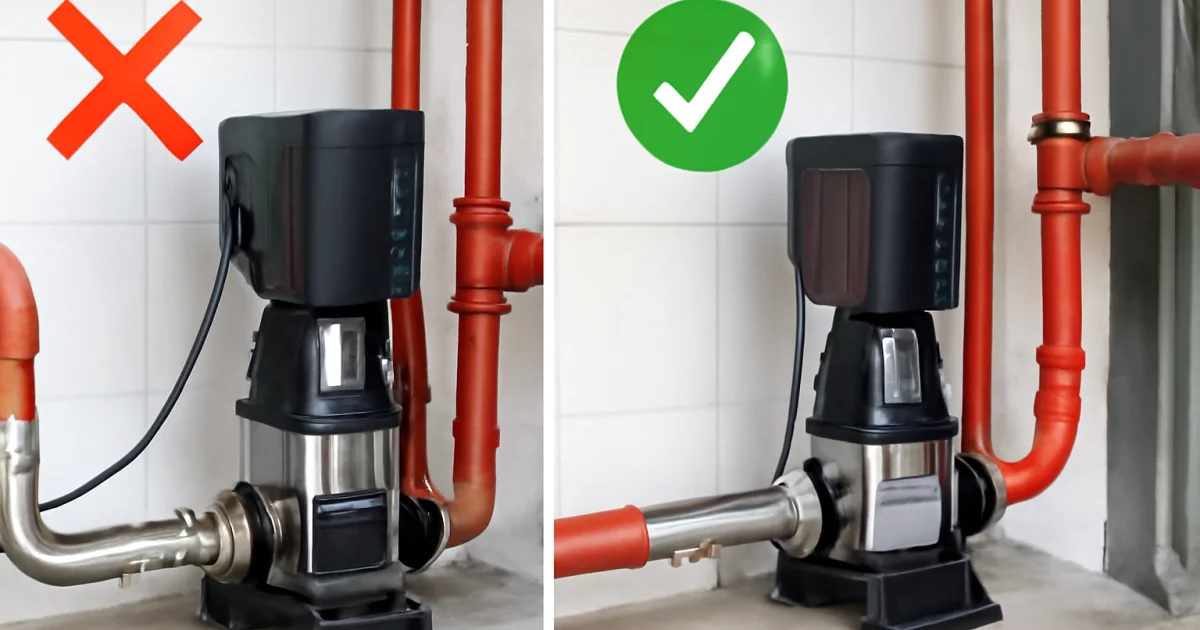
Installing a Grundfos booster pump requires more than connecting pipes and switching on the power. Incorrect positioning, piping, electrical connections, priming or pressure settings can lead to unstable water pressure, excessive noise, repeated shutdowns and premature component wear.
For homeowners, contractors and facility managers in Malaysia, the six mistakes to avoid during Grundfos booster pump installation are:
- Installing the pump on an unsuitable surface or in a poorly chosen location.
- Using incorrect piping, valves or connection methods.
- Overlooking electrical supply and control requirements.
- Starting the pump without correct priming and leak checks.
- Ignoring model-specific instructions and maintenance requirements.
- Selecting a pump that does not match the building’s flow and pressure needs.
These mistakes affect domestic pressure booster pumps as well as larger commercial booster systems, although the installation requirements differ by model. Always follow the installation and operating instructions for the exact pump supplied.
1. Skipping Proper Site Preparation
A booster pump needs a suitable installation location. An unstable mounting surface, inadequate ventilation or poor access can make the system noisier, harder to maintain and more vulnerable to operating problems.
For a compact domestic unit such as the Grundfos SCALA2, the manufacturer recommends a stable, level installation surface and appropriate measures to reduce vibration. Larger booster sets may have different foundation, anchoring and vibration-isolation requirements.
- Why it happens: Installation locations are sometimes chosen for convenience without considering maintenance clearance, drainage, environmental exposure or the manufacturer’s mounting requirements.
- How to avoid it: Check the model’s installation instructions before preparing the location. Provide a stable support, suitable environmental protection, accessible isolation points and adequate space for inspection.
- What to check before commissioning: Confirm that the pump is secure, pipework is independently supported where required, and there is no obvious mechanical strain on the connections.
Practical example: A domestic booster installed on an unstable platform may transmit vibration through the surrounding pipework. The appropriate solution could involve improving the mounting surface, correcting pipe support or using a manufacturer-approved vibration-reduction arrangement.
Do not assume that every booster pump requires an inertia block. Foundation design and vibration control depend on the specific equipment and installation.
2. Incorrect Piping and Valve Arrangement
Poor piping arrangements can restrict flow, increase friction losses and interfere with pump operation. Undersized suction pipes, excessive bends, unsupported connections and incorrectly positioned valves are common issues to investigate.
The correct arrangement depends on whether the system draws water from a storage tank, receives a positive inlet pressure or serves a larger building distribution network.
- Why it happens: Installers may reuse existing pipework without checking whether its diameter, layout and condition are suitable for the new pump.
- How to avoid it: Confirm the required suction and discharge arrangement, pipe sizes, isolation valves, non-return valves and other components against the manufacturer’s instructions and system design.
- What to check before commissioning: Inspect for leaks, unsupported pipe loads, restrictions and incorrectly positioned valves. Verify that the pump can receive an adequate water supply throughout its intended operating range.
Important Connection Precautions for Grundfos SCALA2
Grundfos specifies hand tightening for the pump-side connections on SCALA2. Using a wrench directly on these connections can damage the housing. This instruction is model-specific and should not be applied indiscriminately to every booster pump or pipe fitting.
For further details, refer to the official Grundfos SCALA2 installation guidance.
For larger building systems, our guide to choosing an inline booster pump for a building explains additional selection considerations.
3. Ignoring Electrical and Control Panel Requirements
Incorrect electrical installation can cause equipment faults and create serious safety hazards. Booster pumps may have different requirements for supply voltage, earthing, protective devices, motor controls and variable-speed operation.
Some domestic pumps incorporate their own controls, while larger booster systems may use external control panels, pressure transmitters and variable-frequency drives.
- Why it happens: The electrical installation may be based on an older pump or control arrangement without checking the replacement model’s specifications.
- How to avoid it: Have electrical work performed by appropriately qualified personnel. Confirm the nameplate supply requirements, protective earthing, required protection devices and control compatibility.
- What to check before commissioning: Verify electrical connections, protection settings, control signals and any alarms according to the manufacturer’s commissioning procedure.
Never modify electrical wiring or open electrical equipment while it is energised. Isolate the supply and follow appropriate electrical safety procedures before inspection or servicing.
For a domestic variable-speed example, see the Grundfos SCALA2 variable-speed booster pump.
4. Failing to Prime the Pump and Check for Leaks
Starting a pump without the required water filling or priming can cause dry running, poor performance or damage. Air trapped in the pump or piping can also interfere with normal operation.
Priming requirements vary. Some systems operate with a flooded suction, while others use self-priming arrangements or have specific venting procedures.
- Why it happens: Installers may assume that a self-priming pump can be started without any preparation or that all booster pumps use the same startup procedure.
- How to avoid it: Follow the exact model’s filling, priming and venting instructions before startup. Confirm that the inlet water supply is available and that the relevant valves are correctly positioned.
- What to check before commissioning: Inspect the pipework and connections for leaks, confirm that air is discharged as instructed, and monitor the pump for abnormal noise, vibration or alarms.
Grundfos SCALA2 Priming Example
According to Grundfos’s SCALA2 installation instructions, the pump housing must be filled with at least 1.7 litres of water before initial startup. The startup procedure also involves opening a tapping point to help vent air from the system.
This is an example for SCALA2, not a universal priming volume or procedure for all Grundfos booster pumps.
See the manufacturer’s installation guide for the applicable procedure and precautions.
5. Overlooking Manufacturer Guidelines and Maintenance
Every Grundfos booster model has specific installation, operating and servicing requirements. Ignoring these instructions can contribute to avoidable failures and may affect warranty eligibility, depending on the applicable terms and circumstances.
Installation is also the right time to establish a maintenance baseline. Without initial records, later troubleshooting becomes more difficult because the technician may not know the original pressure settings, operating conditions or alarm history.
- Why it happens: Teams may assume that familiar pump-installation practices apply to every model or may hand over the system without recording its initial settings.
- How to avoid it: Read the relevant installation and operating instructions, retain the equipment documentation and record commissioning settings.
- What to check before handover: Confirm that the operator understands the controls, alarms, isolation arrangements and maintenance requirements.
Do Not Overlook Pressure Tank Pre-Charge
For booster systems equipped with a pressure tank, incorrect pre-charge can contribute to pressure fluctuations or frequent cycling. The correct setting depends on the equipment design and manufacturer’s instructions.
For SCALA2 specifically, Grundfos recommends a tank pre-charge equal to 70% of the selected pressure setpoint, checked with the system stopped and depressurised. Do not apply this percentage to unrelated pressure vessels or booster systems without checking their documentation.
See Grundfos’s SCALA2 pre-charge guidance for the correct model-specific procedure.
6. Not Matching the Pump to System Requirements
A correctly installed pump can still perform poorly if it was selected for the wrong duty. Pump selection must consider both the required flow rate and total dynamic head, rather than motor horsepower or maximum pressure alone.
For example, a two-storey home with several bathrooms has different demand characteristics from a commercial building with multiple floors and changing occupancy. The correct pump must meet the expected operating conditions without excessive cycling or inadequate pressure at the most demanding outlets.
- Why it happens: Buyers may choose a pump based on brand, motor power, price or the specification of an older unit without recalculating system requirements.
- How to avoid it: Determine the required operating flow, available inlet conditions, static head, pipe friction losses and desired outlet pressure. Compare these requirements with the manufacturer’s pump performance curve.
- What to check before commissioning: Confirm that the selected pump and control arrangement can meet expected demand within the manufacturer’s permitted operating range.
For a more detailed explanation, read our water pump sizing guide for Malaysia, which covers flow rate, head and pump selection.
If you are still choosing a pump, our guide to selecting a water booster pump in Malaysia explains the differences between common domestic and commercial options.
Grundfos Booster Pump Installation Checklist Before Handover
Before handing over a new or replacement booster system, the contractor and responsible technical personnel should verify the following items against the approved design and manufacturer documentation.
| Inspection Area | What to Verify | Potential Problem |
|---|---|---|
| Location and mounting | Stable support, access, environmental protection and appropriate mounting | Vibration, noise or difficult servicing |
| Piping and valves | Correct pipe arrangement, valve positions, support and leak-free connections | Restricted flow, leaks or inadequate inlet conditions |
| Electrical system | Supply compatibility, earthing, protection and control operation | Electrical faults or unsafe operation |
| Priming and venting | Model-specific filling and startup procedure completed | Dry running, air-related problems or failure to deliver water |
| Pressure and controls | Setpoints, tank pre-charge where applicable, alarms and demand response | Pressure fluctuations or frequent cycling |
| Documentation | Model details, commissioning records, manuals and maintenance instructions | Incomplete handover and difficult future troubleshooting |
Important: This is a general inspection checklist, not a replacement for the manufacturer’s commissioning procedure, the approved project design or applicable Malaysian electrical and plumbing requirements.
What Should You Check If a Newly Installed Booster Pump Is Not Working Properly?
Not every startup problem means the pump itself is defective. The observed symptom can help identify which part of the installation requires further investigation.
The Pump Runs but Water Pressure Is Still Low
Check whether the inlet supply is adequate, the relevant valves are open, the system has been correctly primed and the selected pump can meet the required flow and head. Also investigate restrictions, leaks and incorrect pressure settings.
The Pump Starts and Stops Too Frequently
Frequent cycling can be associated with system leakage, pressure settings, pressure tank conditions or unsuitable control arrangements. Check the model’s troubleshooting instructions before changing settings.
The Pump Makes Unusual Noise or Vibrates Excessively
Investigate mounting stability, pipe support, trapped air, inadequate inlet conditions and operation outside the intended range. Stop the equipment and arrange qualified inspection if abnormal conditions persist.
The Pump Displays an Alarm or Does Not Start
Record the displayed fault code or alarm indication and consult the exact model’s operating instructions. Electrical, sensor, supply or dry-run protection faults require different responses. Do not repeatedly reset an unexplained fault without identifying its cause.
Practical Tips for a Successful Grundfos Booster Pump Installation
- Confirm the exact pump model and obtain its current installation and operating instructions.
- Check system flow, pressure and inlet conditions before installation.
- Prepare a suitable mounting location with access for inspection and servicing.
- Verify piping arrangements and electrical requirements before startup.
- Complete the manufacturer’s priming, venting and commissioning procedures.
- Record operating settings, inspection findings and any unresolved issues.
- Provide the operator with relevant manuals and maintenance guidance.
Installation quality begins with selecting suitable equipment, such as one of our Grundfos booster sets. If you are comparing options before purchasing, see our guide to common mistakes when buying a water booster pump in Malaysia.
Conclusion
A reliable Grundfos booster pump installation depends on matching the equipment to the application and following the correct model-specific procedures. Suitable mounting, piping, electrical connections, priming and commissioning checks all contribute to stable operation.
For Malaysian homes, commercial buildings and industrial facilities, the most useful approach is to confirm the system requirements before installation, document the initial operating conditions and resolve any abnormal behaviour before handover.
Where installation requirements or pump selection remain uncertain, consult qualified personnel and refer to the relevant Grundfos technical documentation.
Frequently Asked Questions
Does every Grundfos booster pump need to be primed before startup?
Priming and filling requirements depend on the model and installation arrangement. For example, Grundfos SCALA2 requires its pump housing to be filled with water before initial startup. Always follow the instructions for the specific pump rather than assuming all booster systems use the same procedure.
Why does my Grundfos booster pump keep starting and stopping?
Frequent cycling may be associated with leaks, unsuitable pressure settings, pressure tank conditions or control-system issues. Check the model’s fault indications and troubleshooting instructions. The cause should be identified before changing settings or replacing components.
Can I install a Grundfos booster pump myself?
Some compact domestic models have relatively straightforward installation arrangements, but the work must still comply with applicable plumbing and electrical requirements. Electrical modifications should be carried out by appropriately qualified personnel. Larger commercial booster systems generally require professional installation and commissioning.
How do I know whether my booster pump is correctly sized?
Compare the required flow rate and total dynamic head with the manufacturer’s pump performance curve. Consider simultaneous water demand, inlet pressure, elevation, pipe friction losses and control requirements. Motor horsepower alone does not confirm suitability.
What information should I prepare before asking for installation advice?
Prepare the pump model number, application, available water supply, estimated flow demand, required pressure, building height, pipe arrangement, electrical supply and any fault codes. Photographs of the existing installation may also help a technical specialist understand the situation.
Need Help Selecting or Installing a Grundfos Booster Pump in Malaysia?
Choosing the right booster pump and preparing the installation correctly can help avoid pressure problems, unnecessary equipment changes and commissioning delays.
Multipump Sdn Bhd supplies pumping solutions for residential, commercial and industrial applications in Malaysia. If you are planning a new booster system or reviewing an existing installation, share your pump model, building requirements and available system details for further discussion.
Contact Multipump Sdn Bhd About Your Booster Pump Requirements