

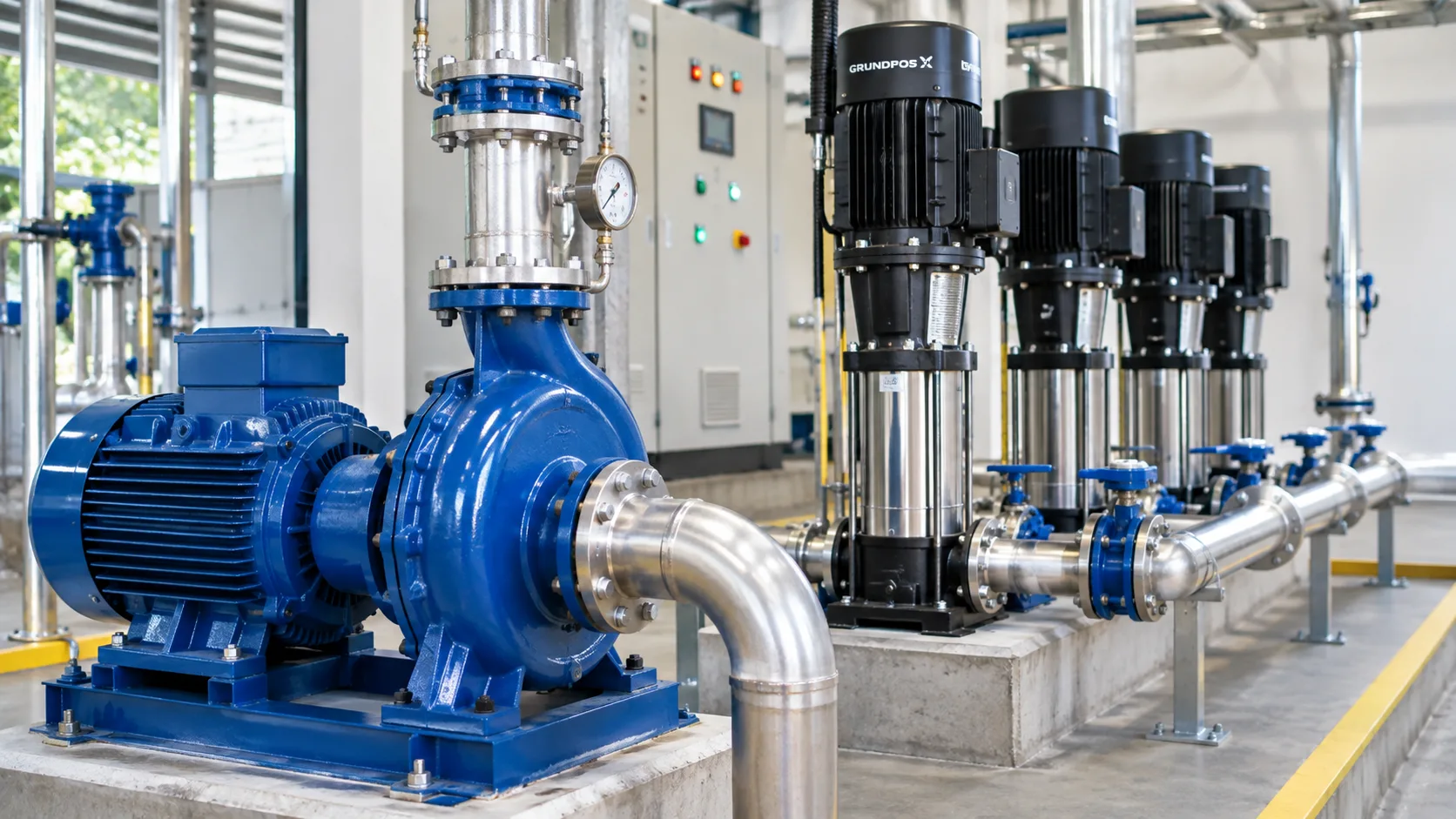
A single-stage pump uses one impeller, whereas a multistage pump uses two or more impellers arranged in series to build additional head. For Malaysian facilities, the practical difference is not simply that one pump is “stronger”. A single-stage model may suit a water-transfer or circulation duty, while a multistage design can be attractive when a system needs substantially more head at a particular flow rate. Neither configuration is automatically more efficient or suitable for every installation.
This guide helps facility managers, project engineers, contractors and procurement teams compare single-stage vs multistage pumps without confusing impeller design with motor horsepower or pump layout. It extends our beginner’s guide to water pump types in Malaysia by examining how the number of hydraulic stages affects selection, energy use and maintenance. It also explains what to include in a pump quotation request.
What Is the Difference Between a Single-Stage and Multistage Pump?
The stage count tells you how many impellers add energy to the liquid within a pump. A single-stage centrifugal pump contains one hydraulic impeller. A multistage centrifugal pump routes the liquid through successive impellers, generally raising the total developed head across the assembly. The stages work in series, so the water receives additional energy at each stage.
For example, an illustrative two-stage arrangement does not produce twice the flow merely because it has two impellers. It is intended to develop more head than a comparable single-stage arrangement at the relevant flow, subject to hydraulic design and losses. Different impeller geometries, speeds and pump sizes also affect the result, so stage count cannot replace a performance curve.
Malaysia’s Public Works Department (JKR) describes single-stage and multistage centrifugal arrangements in its Guidelines on the Design of Internal Cold Water System (Section 6.1.1). This is useful design guidance for understanding pump construction, not a substitute for the current project specification, manufacturer’s instructions or local approval requirements.
One terminology trap matters: a multistage centrifugal pump is still a centrifugal pump. “Centrifugal vs multistage” is therefore not a technically precise either-or comparison. The meaningful comparison here is one hydraulic stage versus multiple stages within the centrifugal-pump family.
Single-Stage vs Multistage Pump: Side-by-Side Comparison
The table summarises typical design tendencies. It does not guarantee a particular performance range, purchase price or service life; those depend on the actual pump model and operating environment.
| Selection factor | Single-stage centrifugal pump | Multistage centrifugal pump |
|---|---|---|
| Impellers | One hydraulic impeller | Two or more impellers arranged in series |
| Developed head | Can meet a wide range of duties; available head depends on the design | Commonly selected when the required head is better met by several stages |
| Flow rate | Model-specific; some designs handle high flow | Also model-specific; adding stages does not simply multiply flow |
| Typical installation | End-suction, in-line and split-case designs | Vertical in-line, horizontal multistage and other specialised designs |
| Maintenance | May have simpler hydraulic assembly, but access depends on coupling and casing | More stages may add components and servicing complexity; model matters |
| Efficiency | Depends on duty point, hydraulic design, control and system losses | Also depends on those factors; not automatically more efficient |
| Examples of applications | Plant water transfer, cooling-water circulation, general building services | Higher-head water supply, pressure boosting and selected industrial processes |
These are tendencies rather than rules. Some single-stage designs develop considerable head, while particular multistage models may have a limited operating flow. The supplier must confirm that the chosen unit actually covers the required duty within its permitted operating region.
How Does the Number of Stages Affect Pump Pressure and Flow?
More stages generally increase the head a pump can develop, but they do not create an equivalent increase in flow. In a series arrangement, each impeller adds hydraulic energy to the same liquid stream. The overall result depends on the stage characteristics and internal losses.
This distinction becomes useful when a buyer says, “We need a stronger pump.” The supplier needs to know whether “stronger” means more water per hour, more pressure at an outlet, or both. A system that needs higher flow at moderate head may require a different pump size or configuration, not simply more stages.
Pressure and head are related, but they are not interchangeable specifications without context. For water near ambient temperature, approximately 10 metres of pressure head corresponds to around 1 bar of pressure difference. However, the pump’s total developed head is not necessarily the pressure available at the furthest outlet: elevation, pipe friction, upstream pressure and system layout must all be considered.
In addition, a pump’s maximum advertised head may occur at very low or zero flow. Buyers should therefore avoid pairing the maximum head on one part of a catalogue with the maximum flow stated elsewhere as though both occur simultaneously.
Start With the Duty Point: Flow Rate, Total Head and Pump Curve
The correct first step is to define the operating duty point, not to choose a stage count. The duty point expresses the required water flow at the head the system imposes, commonly written as Q m³/h at H metres. Those two values must refer to the same intended operating condition.
For a building transfer pump, the head assessment may include changes in water level, required receiving pressure and friction losses in pipes, valves and fittings. In a closed chilled-water circuit, by contrast, the static elevation through the circulating loop generally balances; the pump must chiefly overcome circuit resistance at the target flow, although system pressurisation and component limitations still matter. Treating every tall building as a fixed additional static-lift requirement can lead to oversizing.
The Hydraulic Institute’s explanation of pump curves identifies head, flow, efficiency, input power and NPSH information as essential selection data. Use these alongside your system curve to establish the actual operating point.
If you need to calculate those inputs before comparing equipment, refer to our water pump sizing guide for Malaysia. The article you are reading addresses the subsequent design choice: whether a single-stage or multistage configuration is appropriate after hydraulic requirements are known.
Four questions that matter on every pump curve
- Does the curve reach the duty point? Check the required flow and head together at the stated speed and impeller arrangement.
- Where is the duty relative to the best efficiency point (BEP)? Compare the intended operating region with manufacturer guidance, not just peak efficiency.
- What is the required shaft/motor input? Assess the motor rating across the expected operating range and starting/control arrangement.
- Are suction conditions adequate? Check net positive suction head available (NPSHA) against the manufacturer’s required NPSH and design margin to reduce cavitation risk.
These checks explain why two pumps with identical motor power may deliver very different combinations of flow and head. A motor label alone cannot establish that either pump will perform the required task.
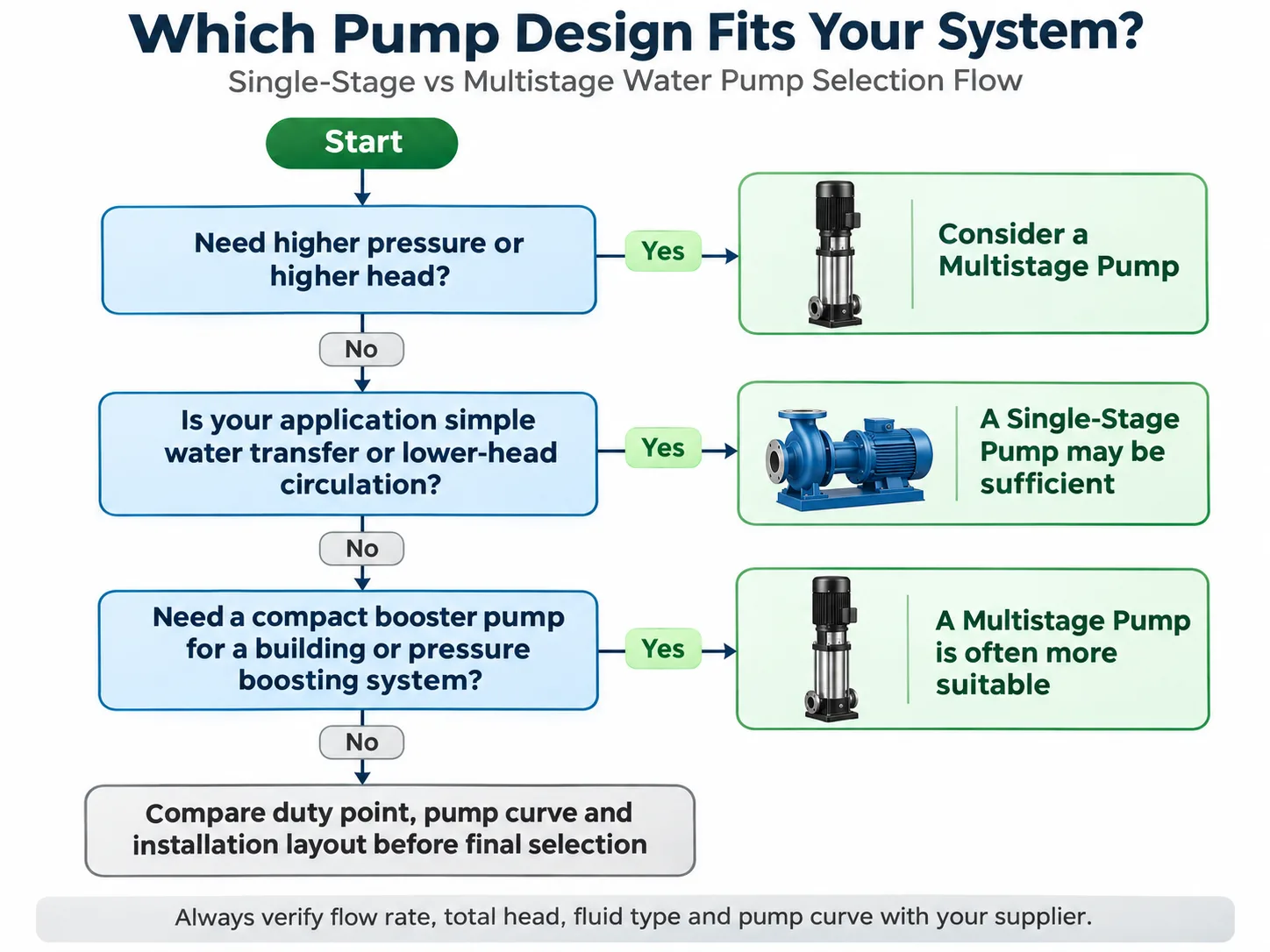
Quick Selection Flowchart: Which Pump Design Fits Your System?
The decision chart below offers an initial screening route based on the required head, water-transfer duty and building pressure-boosting needs. It is a starting point for discussion, not a substitute for checking the proposed model against the system duty point and manufacturer performance data.
Which Pump Works Better for Real Malaysian Building and Factory Applications?
The following scenarios show how an engineer might narrow the options. All duty figures are illustrative assumptions, not measured Multipump projects, approved pump specifications or guaranteed manufacturer performance.
| Illustrative duty | Initial shortlist | What still needs checking |
|---|---|---|
| Factory transfer: 45 m³/h at 28 m head, clean process water | Suitable single-stage end-suction or in-line design may be practical | Actual system curve, suction arrangement, operating hours and efficiency |
| Higher-head building supply: 15 m³/h at 85 m head, treated water | A multistage pump may provide a suitable high-head configuration | Pressure zones, discharge pressure limits, controls, redundancy and suction conditions |
| Cooling-water circulation: variable demand through a closed loop | Either design may work; compare actual curves and control requirements | Pipe resistance, control valve behaviour, minimum flow and variable-speed suitability |
Example A: A factory moving water between two tanks
Suppose a plant needs to transfer clean utility water at the first illustrative duty above. A single-stage end-suction unit could be a sensible first candidate because its hydraulic capability may meet the required flow and head without an unnecessarily complex assembly. Yet an engineer still needs the real suction water level, piping losses and duty cycle to verify whether this candidate will operate efficiently.
Multipump’s end-suction centrifugal pump range provides a commercially relevant starting point. Its industrial end-suction selection guide addresses the installation and application details that follow this initial comparison.
Example B: A building requiring a higher-head clean-water supply
Now consider a building supply duty of 15 m³/h at 85 m total head. A vertical multistage arrangement may be appropriate because several impellers can provide the required hydraulic head within a compact footprint. Nevertheless, the design must consider pressure zoning, pipe pressure ratings, tank levels, operating controls and whether the required flow varies significantly throughout the day.
Multipump lists the Grundfos CR vertical multistage centrifugal pump and a broader in-line multistage pump range. These links identify relevant product families, not approval of any model for the hypothetical duty. The supplier needs the selected model’s detailed curve and installation conditions before confirming suitability.
Example C: An HVAC circulation loop
Consider a chilled-water loop serving several floors of a commercial building. If the circuit is closed and completely filled, its circulation pump does not ordinarily need to overcome the building’s full vertical height as an additional static lift on every circuit. Instead, the hydraulic calculation focuses on resistance through distribution pipes, fittings and equipment at the required flow. The final pump may be single-stage or multistage depending on the calculated head, available space and operating range.
This is an area where a Grundfos TP single-stage in-line centrifugal pump may be relevant for review. The manufacturer’s curve and application constraints must decide the outcome; the number of storeys alone cannot.
Is an End-Suction Pump the Same as a Single-Stage Pump?
No. “End-suction” describes the inlet arrangement; “single-stage” describes the number of impellers. Similarly, “in-line” describes a piping arrangement, while “multistage” describes the hydraulic stages. These characteristics can overlap. A pump can be an end-suction multistage design, or an in-line single-stage design.
This distinction prevents a common procurement error: specifying “end suction” when the real objective is “one impeller”, or requesting “vertical pump” when the functional requirement is high head.
| Description | What it tells the buyer | Verified Multipump example |
|---|---|---|
| Single-stage in-line | One stage; suction and discharge designed for in-line pipework | Grundfos TP |
| Single-stage end-suction | One stage with an end-suction inlet arrangement | Grundfos NB |
| Vertical multistage | Several stages arranged in a vertical assembly | Grundfos CR |
| Horizontal multistage | Several stages in a horizontal assembly | Grundfos CM/CME |
These examples show the available equipment families on Multipump’s website. They do not establish stock availability, a confirmed quotation, certification or suitability for a particular installation. For the broader choice of pump types, return to our water pump types overview.
Which Design Is More Energy Efficient and Cost-Effective?
Neither pump type is intrinsically the most efficient across all operating conditions. A well-matched single-stage pump can outperform an unsuitable multistage unit, and the reverse can also be true. Energy use depends on the hydraulic duty, the efficiency curve, motor performance, control method, operating hours and system resistance.
The U.S. Department of Energy’s Pump Systems resources emphasise matching pumps to system requirements, using appropriate control strategies and evaluating pumping-system efficiency. This supports comparing whole-system performance rather than selecting a pump simply because it has more stages or a higher horsepower label.
For example, a pump running continuously at a poorly matched duty can consume unnecessary electricity even if its rated efficiency looks impressive in a catalogue. Conversely, a unit with slightly higher procurement cost may make sense if its verified operating-point efficiency, service requirements and expected operating hours justify that expense.
Compare both purchase costs and lifecycle costs: equipment, foundations or supports, pipework, installation, controls, energy, spare parts, planned service and downtime. Do not invent a universal percentage saving or use an unverified price range to decide between configurations.
What about variable-speed drives?
Variable-speed drives can help a centrifugal pump respond to variable system demand, but they must be paired with a compatible motor, suitable control strategy and validated operating range. They do not correct every suction, pipe-sizing or pump-selection problem. Multipump lists control-panel upgrades, VFD solutions, on-site testing and pump servicing, making these relevant questions for a complete project enquiry.
What Are the Most Common Installation and Reliability Mistakes?
The stage count is only one part of reliable pumping. A correctly chosen hydraulic design can still perform badly when suction or installation conditions are unsuitable.
- Ignoring NPSH and priming: Check NPSHA against the specified NPSHR and manufacturer’s margin. A pump’s number of stages does not remove the risk of cavitation or air locking.
- Specifying horsepower instead of duty: A motor rating says little about how much flow is delivered at the required head.
- Assuming more stages automatically mean more flow: Series impellers primarily build head, while flow must still be verified on the pump curve.
- Confusing pump stages with pumps in parallel: Multiple pumps operating in parallel are a system arrangement, not a single multistage pump; performance depends on their combined curves and control logic.
- Ignoring liquid properties: Abrasive solids, viscosity, temperature and chemical exposure may demand different materials, seals or a different pump family entirely.
- Neglecting maintainability: Allow space for isolation, motor removal, seal servicing, coupling alignment and safe lifting where needed.
- Oversizing for an uncertain future duty: Extra head or flow capability can move the operating point away from an efficient region and complicate pressure control.
Where a system already experiences vibration, leaks or premature bearing wear, investigate alignment, suction conditions, actual duty and system operation before replacing the pump with a different stage count. For end-suction equipment, our end-suction centrifugal pump maintenance guide provides a more detailed maintenance-focused discussion.
Supplier Checklist: What Information Should a Pump Quotation Include?
Ask suppliers to demonstrate that the proposed unit meets your defined duty, not merely that it has an attractive headline capacity. Supply the same technical requirements to every bidder so you can compare the proposals fairly.
| Requirement | What to provide or request | Why it matters |
|---|---|---|
| Liquid | Source, quality, temperature, solids and any chemicals | Materials, seals and hydraulic suitability |
| Flow and head | Normal, minimum and peak flow at corresponding total head | Defines the operating range, not just one catalogue maximum |
| Suction conditions | Tank levels, suction pipe route, fluid temperature and NPSH data | Priming and cavitation assessment |
| Site and power | Pump-room dimensions, supply voltage/frequency, access, controls | Installation, motor and control compatibility |
| Pump datasheet | Exact model code, stages, Q–H curve, efficiency, power and NPSHR | Verifies design and duty-point performance |
| Commercial package | Accessories, installation scope, testing, manuals, spare parts, warranty | Allows like-for-like quotation comparison |
Practical enquiry example: “We need a clean-water pump for an indoor factory transfer system. The preliminary duty is 45 m³/h at 28 m total head; the water comes from a ground-level storage tank. Please review a suitable single-stage or multistage design and provide the exact pump curve, efficiency at duty, suction requirements, materials, motor details and service scope.” This is a more useful starting point than “Please quote a 5 HP pump.”
For an existing installation, attach photographs of the nameplate, pump layout, pressure readings and known operating problems. A site survey or performance test may be necessary to verify assumptions before any replacement recommendation.
Conclusion: Choose by Hydraulic Duty, Not by the Number of Impellers Alone
Single-stage and multistage centrifugal pumps solve overlapping but distinct hydraulic problems. A single-stage pump can be an economical, serviceable option when it meets the required flow and head. A multistage arrangement becomes particularly useful when several impellers provide a better way to develop the necessary head. Neither choice removes the need to consider the complete pumping system.
Define the duty, assess the pump and system curves, check suction conditions and compare life-cycle requirements before selecting a model. This approach is more defensible for industrial buyers, commercial building managers and contractors than purchasing by stage count, advertised maximum head or motor horsepower alone.
Frequently Asked Questions
Is a multistage pump always better than a single-stage pump?
No. A multistage pump can be useful when higher head is required, but a single-stage pump may meet the same project duty with an appropriate model. Compare flow, head, efficiency, suction conditions and maintenance requirements before deciding.
Does adding more impellers increase the flow rate?
Not automatically. Impellers arranged in series primarily increase developed head. The delivered flow is determined by the pump curve and the system it operates in, so the manufacturer must confirm the duty point.
Can an end-suction centrifugal pump also be multistage?
Yes. End-suction describes the inlet arrangement, while multistage describes the number of impellers. These are separate characteristics. Always check the manufacturer’s precise model description.
Which pump type should a factory use for cooling-water circulation?
Either type may be suitable, depending on the required flow, loop resistance, controls and operating range. In a completely filled closed circuit, the vertical loop height does not automatically become additional pump static lift. Verify the system curve and pump performance data.
Is a multistage pump necessary for a high-rise building?
Not always. Multistage pumps are commonly evaluated for higher-head water supply, but the building’s pressure zones, tank positions, required flow, discharge-pressure limitations and hydraulic calculations determine the actual pump arrangement.
Does a higher horsepower pump deliver higher pressure?
Not necessarily. Motor power alone does not state the delivered flow and head. A pump with a larger motor can still be unsuitable at the required duty point. Compare manufacturer Q–H curves, motor loads and the expected operating range.
What should I send Multipump to compare single-stage and multistage models?
Send the liquid type and temperature, target flow and total head, suction tank levels, pipework and site details, operating hours, power supply and any existing pump information. Ask for model-specific curves, efficiency, NPSH requirements, installation scope and service arrangements.
Compare Single-Stage and Multistage Pumps with Multipump
Multipump Sdn Bhd supplies and services centrifugal, in-line, multistage and other pump systems for customers in Malaysia, particularly the Northern Region. Share your intended flow, total head, liquid characteristics and existing installation details so the technical team can review an appropriate pump family and advise on the next steps.
Explore the single-stage in-line range and multistage in-line range, or contact Multipump for an application-based pump enquiry.